Sunday, April 19, 2009

Montecasino - Bird Show - Part 4

So many of these owl shots came out nice that I could not decide which to post and so ended up with all of them...

The Cape Eagle Owl can be seen in many parts of southern Africa, but nowhere is it common. It lives in rocky, sometimes mountainous areas, in various vegetation types. Most of its diet consists of mammals, but it also feeds on birds and invertebrates. Amazingly, it can carry prey that is 4,5 kg, or 4 times its weight! It lays 1-3 eggs, and incubation lasts for 34-38 days, the female doing most of it, with the male sometimes taking over while the female feeds. After fledging, juveniles stay dependent on their parents for 2-3 months, before leaving completely.
It has an extremely fragmented range, and they are no places where you can see it easily. It prefers mountainous areas with cliffs, outcrops and gorges, and can live as high as 2500m above sea level.
Its diet consists mostly of mammals, although it varies between regions. It also eats a number of birds species, as well as invertebrates. It hunts at night, searching for prey on low perches.
It uses scrapes in the ground as nests, often on ledges, hidden by trees or rocks, in cliff recesses, regularly near streams or rivers. Females often lie in the scrape for days before laying their eggs.
It sometimes uses the same nest site repeatedly, but not every year.

Sunday, April 12, 2009

Montecasino - Bird Show - Part 3

The Gymnogene (now renamed African Harrier-hawk) is found in most areas of SA. They are fairl large in size and easily distinguished by their pink beak and yellow legs. They are usually solitary and hunt by raiding nests of other birds such as weavers and swallows. In courtship flight, the male rolls over and touches the talons of the female.
Great White Pelicans breed in Africa, and in Europe and Asia from Greece to Vietman. The world's population is thought to total about 90 000 pairs, of which about 80% are in Africa.
Their diet consists of fish and some crustaceans. I love the way I managed to catch this one skimming along prior to landing in the water.
Great White Pelicans are gregarious birds and large flocks often fish together encircling and trapping shoals of fish in shallow water where all the birds are easily able to scoop up fish in the skin pouch below the bill. They are excellent swimmers and also good fliers.
White Pelicans usually nest in colonies situated on an island, or remote parts of a large pan. The nest is a stick structure placed on the ground.
A single, strange colored Peacock was sitting above the building watching the show too.
The Spotted Dikkop has large eyes as he is a nocturnal bird and is very vocal, especially after rain. They eat grass seed, insects, crustaceans and frogs.
Crested Guineafowl prefer matted thickets at the edge of grasslands. They are found in flocks of up to 30 birds and will follow troops of monkeys to feed on fallen fruit.

Friday, April 10, 2009

Yellow Mongoose

Living in colonies of up to 20 individuals in a permanent underground burrow complex, the yellow mongoose will often co-exist with ground squirrels or Suricates and share maintenance of the warren, adding new tunnels and burrows as necessary. The tunnel system has many entrances, nearby which the yellow mongoose makes its latrines. They hunt for insects and birds or eggs in the daytime and sometimes at night.
They also share a broadly similar diet (mainly insects) but differ ecologically in that Suricates locate much of their prey by digging, whereas Yellow Mongooses are surface foragers.

Members of these species don't all look alike: in the warmer north, the yellow mongooses are grey and have shorter hair and tails, and smaller bodies, than their southern counterparts.

Sunday, April 5, 2009

Montecasino - Bird Show - Part 2

To the casual observer the massive Marabou Stork with its balding, scabby head and pendulous pink air sac may appear to be one of the ugliest creatures in the world. If this same observer were to notice the Marabou's fondness for carrion and its habit of squirting excrement onto its own legs he or she would probably consider the original opinion to be justified. It takes a real bird lover to see past all of this stork's bizarre adornments to recognize the scruffy charm underneath.
A large male Marabou Stork, standing up to 1.5 m tall and weighing nearly 9 kg, is one of the largest flying birds in the world. Their wingspan approaches 2.9 m. Females are generally smaller.

Marabou's evolved their naked heads and necks as an adaptation for feeding on large animal carcasses without getting their head feathers soiled with blood and gore. More than 200 Marabous were seen feeding on a single elephant carcass in Kruger National Park. They rely on vultures and other scavengers to open the tough outer hides and then use their cleaver-like bills to retrieve and then swallow surprisingly large pieces of meat. They are not above stealing morsels from other smaller scavengers.
Marabou Storks will eat just about any kind of animal, dead or alive. Living prey includes termites, fish, locusts, grasshoppers, army-worm caterpillars, frogs, rodents, crocodile eggs and hatchlings, quelea nestlings, doves, young and adult flamingos, cormorant nestlings, and pelican chicks.
The principal food of the Wattled Crane is aquatic vegetation, including the tubers and rhizomes of submerged sedges and water lilies. In particular, Wattled Cranes depend heavily on the sedge Eleocharis spp. In dryer upland habitats, Wattled Cranes forage for grain, grass seeds, and insects, and they make use of agricultural fields when convenient.

In Ethiopia, Wattled Cranes take advantage of beetle larvae and other invertebrates that occur in the spoil heaps created by the giant molerat!
The Toco toucan is at home in South America's tropical forests but recognized everywhere. The toucan's oversized, colorful bill has made it one of the world's most popular birds.Their average lifespan in the wild: Up to 20 years.
The 7.5-inch-long (19-centimeter-long) bill of both sexes is made of the same substance as you finger nails and is used to catch tasty morsels and pitch them to one another during a mating ritual fruit toss. In addition to fruit, they eat insects and, sometimes, young birds, eggs, or lizards.
Toucans nest in tree holes. They usually have two to four eggs each year, which both parents care for. Young toucans do not have a large bill at birth—it grows as they develop and does not become full size for several months.

Sunday, March 29, 2009

Montecasino - Bird Show - Part 1

They have a couple of shows per day during which they tell you a bit about the birds and see them performing some tricks.

The Ground Hornbill: At present Southern Ground Hornbills are considered ‘vulnerable’ but their numbers are still declining.
There are probably only 1500 birds in South Africa—half of which are in the protected areas of the Kruger National Park.
Groups consist of 2—9 birds, of which there is only 1 breeding female.
From which an average of only 1 chick is raised to adulthood every 9 years.
One of their natural sources of food is snakes which they take and shake vigorously before eating. After this one demonstrated his skill with a rubber one, he went over to his trainer to get his reward.
Blue Cranes are the national bird of South Africa. One of the smaller crane species, the Blue Cranes plumage is silvery bluish gray becoming darker on the upper neck and the lower half of the head and nape.
Jackal Buzzard - (Please see Philips fantastic photograph and more information.) They nest between May and October in by building a bulky pile of sticks on a cliff ledge or sometimes in trees especially pines. The bowl is lined with leaves and usually two eggs are laid which are chalky white splotched with red-brown.
They hunt by stooping from flight or gliding from a perch, taking small mammals up to the size of a dassie(hyrax), birds up to the size of a francolin, reptiles, insects, road-kills and carrion.

During the demonstration it was mentioned that if the female is not satisfied with her male she will kick him out and find a new one. :) How true this is I do not know, but I love the thought. LOL!! (Sorry guys, but its a girl thing!!) :)

Tuesday, March 24, 2009

Mudskippers

Mudskippers (Periopthalmus koelreuteri), also known as mudhoppers, are small, maybe 3 inches in length at most.

Photographed in a mangrove swamp on the coastline, mudskippers exist along the edges of muddy puddles and lagoons within mangrove environments or other intertidal zones.
These creatures are adapted to survive in water and on land. They breathe through gills under water and breathe air on land through blood-rich membranes at the back of the mouth and throat.

Tuesday, March 17, 2009

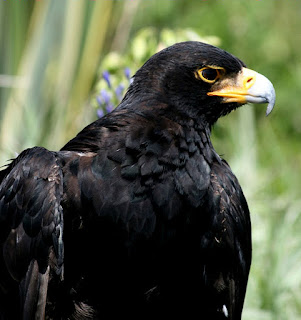
Black Eagle

This was much too easy for all you clever people . Well of course TWO people were wrong again as usual. I just dont know what to do with the two of them. They are going to have to come to Africa and see some live animals and birds for themselves. LOL!! Everyone guessed it was a bird of some kind. :) Thanks for playing everyone.

The Black Eagle is one of the largest eagle species we have here.
Eagle pairs spend approximately 95% of the daytime together. They will perch, fly and hunt together, should the female fly to the nest site the male will follow and usually hops onto the surrounding rocks. After eggs are laid and when there is a young chick on the nest paired black eagles spend very little time together. During nest building 77% of their time is spent together but this decreases dramatically to 6% during incubation. As the young eaglet grows the time spent together by black eagle pairs gradually increases again.
The female black eagle is in charge of the nest site and can spend up to 94%-97% of her time alone on the nest, whereas the male will only spend 1%-5%. The eagles have had to adapt their prey base to include guinea fowl, francolin, red rock rabbit and in desperation the easiest prey –chickens, although this does not happen very often. The female may solicit mating by walking towards, or facing her mate bending forward, the male will mount her with much wing flapping. Copulation has been timed from a few seconds up to 12 seconds only. Mating can occur many times in one day.

They are very easily distinguished by the white V on their backs.
Two creamy white eggs are laid four days apart followed by a 44/45 day incubation period, both eagles sharing the incubation (approx 70% female 30% male - this varies from season to season), the fluffy white chicks are hatched 4 days apart. During incubation the adult birds will eat away from the nest so as not to damage the eggs.