Saturday, July 14, 2012

Milkweed (Asclepias fruticosa)

Family Asclepiadaceae
It is often planted in gardens (it is frost-sensitive, requires full sun and well-drained soil and should be regarded as invasive), particularly because it attracts butterflies (Monarch and Swallowtail), but also crab spiders, ladybirds/bugs, bees, wasps, ants and moths. Some feed on the nectar and the plant itself while others feed on the insects attracted to it.

Milkweed not only provides food for the adult Monarch but also a nesting area for eggs and larvae. It can have a deep root system once it becomes established and is then difficult to eradicate from gardens.
The plant is quite toxic because it produces a group of toxins known as cardenolides. The poisons protect the plant against herbivores. However, some animals and the ostrich, are capable of eating the plant without ill effect.
Thus the Monarch caterpillar is among a select few creatures able to graze on the leaves of the milkweed. It manages to sequester and store poisons so that the butterfly into which it develops is protected from predators.
The female Monarch butterfly lays her eggs on the underside of the leaves where they hatch in about 5 days. The young caterpillar chews itself out of the shell which it then eats as its first meal.

Stems contain a strong, silky bark fibre formerly used for sewing. The milky latex reportedly effective in removing warts. Seed hairs formerly used as tinder and to stuff pillows and mattresses.

Medicinal
A leaf infusion, taken by mouth, is used to treat intestinal troubles (diarrhoea and stomach pain) in children and, given per rectum, as a purgative. Dried powdered leaf is inhaled as a snuff for the relief of headache, coryza and tuberculosis.


Precautions
In view of the possibility of cardiac, uterotonic and antihypertensive activity, preparations of this species should be used with caution, on prescription from a competent traditional practitioner.


Thursday, July 12, 2012

Yellow Tree Bauhinia (BauhiniaTomentosa)

Family Caesalpinioideae
This medium to large shrub with its attractive light green two-lobed leaves produces beautiful bright yellow flowers with black to maroon coloured centres from December to March.


Description
Medium to large shrub to a small tree, up to 4m in height. Leaves are divided into two lobes, light green in colour, with a leathery texture, carried on branches that are often drooping. It produces large bell-shaped, bright yellow flowers with a black to deep maroon coloured centre from December to March. The fruit are pea like, slender and velvety. They are light green, turning a pale brown with age and are produced from January to June or even later. Bark is grey or brown.
 Derivation of name and historical aspects.

The genus name " Bauhinia " honours herbalist brothers from the 16 th century, Johann and Caspar Bauhin. They were identical twin brothers, making it a very apt name as the two lobes of the leaves, when folded together, are identical.
 Previously a large genus, it has now been divided into a number of genera according to the flower shapes. Several South African bauhinias are in cultivation including the well-know Pride of De Kaap - Bauhinia galpinii and Bauhinia bowkeri.


The specie name "tomentosa" means hairy and it refers to the velvety/ hairy pods.
 Ecology

The flowers from this tree, rich in pollen and nectar, attract various insects such as butterflies and bees. In turn these insects will attract insect eating birds. Certain birds and the larvae of certain moth species feed on the flowers. This is also a host plant for many butterfly species, with the larvae feeding on the leaves.


Uses and cultural aspects

Not much is known about the specific medicinal or cultural uses of this specie of Bauhinia, although it is said to be used widely medicinally.


Three other species of Bauhinia are also used medicinally for everything from coughs, convulsions and constipation to pneumonia and venereal diseases. ( Bauhinia galpinii, Bauhinia thonningii, Bauhinia petersiana)
Information from: http://www.plantzafrica.com/

Tuesday, July 10, 2012

Prickly pear cactus (Cylindropuntia iImbricata)

Family Cactaceae
In South Africa the prickly pear is a very popular fruit in summer and it is also made into a wonderful and refreshing health drink.

Prickly pear cactus (Opuntia ficus-indica) is a flower- and fruit-bearing cacti plant that has been used for centuries by indigenous Mexican tribes to treat a variety of ailments and conditions. In the wild, prickly pear cactus grows in desert-like conditions, but it is now grown commercially in many European countries.
 As a dietary supplement, prickly pear cactus is available in powder or pill form. Prickly pear cactus is also available as a food item in North American supermarkets.

What Does It Do?

And What Scientific Studies Give Evidence To Support This?
 Prickly pear cactus is a rich source of flavanoids, including kaempferol, quercetin, kaempferol 3-methyl ether, quercetin 3-methyl ether, narcissin, dihydrokaempferol (aromadendrin, 6), dihydroquercetin, and eriodictyol. These flavanoids are responsible for its health-enhancing benefits.

Traditional Mexican indian tribes have used prickly pear cactus as a food item and a medicinal plant. Mexico has a hot, arid, desert climate, and this makes agriculture difficult in the absence of irrigation technologies.
 Thus, very few plant species can survive under these dry conditions. Out of necessity (and in the absence of other plant life), prickly pear cactus has been used as a food item by Mexican Indian tribes. It has been used to make jellies, soups, pickles, and even cheese products.
 Medicinally, prickly pear cactus has been used to heal superficial wounds (cuts and scrapes), and, like Aloe Vera, is usually applied topically.
Information suppled by:


Sunday, July 8, 2012

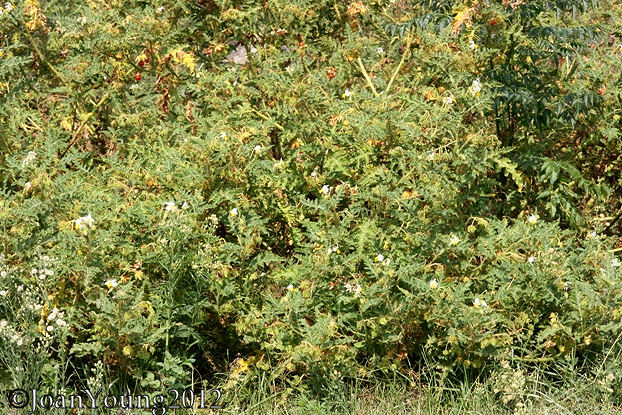
Wild Tomato (Solanum sisymbriifolium)

Family Solanaceae
This is makes a thick, sprawling bush which grows to about 1m (3’) in height
 It is an invasive plant on which a leaf-feeding tortoise beetle has been released to act as a bio-control agent.
 It is not edible except for the seeds which are eaten by birds. 


Identification from: http://www.ispot.org.za

Friday, July 6, 2012

Barley Sugar Bush (Pollichia campestris)

Family Caryophyllaceae
A small, sprawling bush maybe 20cm in height with a jelly-like flower which the Francolin love to eat. Sometimes the little bush consists of only a few branches.
Also know as: Wild Sugar Bush, Waxberry plant; Teesuikerkaroo
 The waxy parts of the fruit have a sweet taste and was apparently used by the boers

during the Great Trek as a sweetener (crushing and crystallizing these flower parts)
hence the name Teesuikerkaroo.
 The steam of an infusion made from this plant is believed to open blocked nasal passages and to treat bronchitis. A popular medicinal use of this plant includes placing warmed leaves externally to help soothe aching muscles and joints, and bruises.
 Information from:

Identification from: http://www.ispot.org.za/

Wednesday, July 4, 2012

Rosewood (Tipuana tipu)

Family Fabaceae
Tipuana tipu, known as Rosewood and is a South American tree of the genus Tipuana. Tipu trees can reach 100 feet in height and 60 feet wide. They are known for being shade trees. Tipu leaves vary in size from 1/2 inch to 3 inches or more and they grow in clusters. The flowers are bright yellow in color and bloom only briefly in the late summer. The fruit is a samara, with the seed at one end.

 It is a deciduous tree, shedding all of its leaves and large "helicopter" seed packets from January-May each year. The debris can be quite a nuisance. The tree is known for having a very aggressive root system. The tree roots can easily lift up concrete and asphalt. Precautions should be taken when planting near buildings, homes, or pools, as they are likely to be damaged. Damage may sometimes be averted by trenching near the structure to a depth of about 1 metre and filling the trench with building rubble or lining the trench with thick plastic sheeting.
 In Southern California, an insect called Tipu Psyllid has invaded several trees.
 Also known as the "Pride of Bolivia".
 This tree is viewed as an invasive weed in some countries. It produces masses of seeds, most of which succeed in germinating, and it can withstand a very wide range of growing conditions, from -4 degrees C to salty soils to drought.
 The species is a food plant for spittlebugs such as Ptyelus grossus.


Information from: http://en.wikipedia.org/wiki/Tipuana_tipu

Identified by: http://www.ispot.org.za/

Monday, July 2, 2012

Wild Tobacco (Solanum mauritianum)

Family Solanaceae
Also known as Bugweed or Bug Tree.


This is a very leafy shrub which grows to about 4m in height and an introduced alien species from South America now localized in many temperate countries.
The berries are eagerly eaten by bird which distribute the seeds.
 Certain Skippers lay their eggs on the leaves for the hatching larvae to eat.