Thursday, March 14, 2013

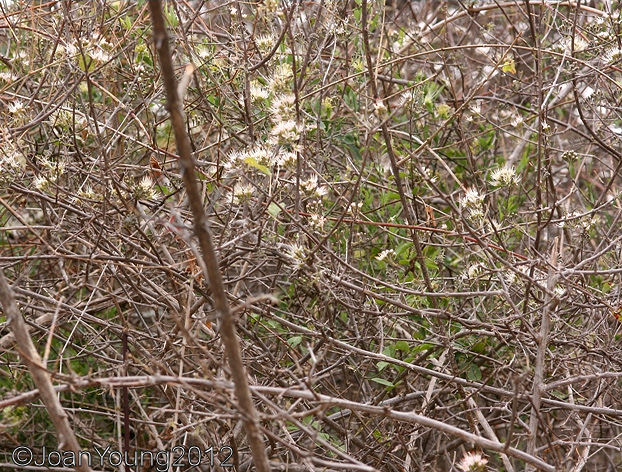
Bushveld Grape (Cissus rotundifolia)

Family Vitaceae
 A climber found in dry woodland and bush in the Limpopo and Mpumalanga regions.
 It has no flowers and the fruit is eaten by birds.

Tuesday, March 12, 2013

White Shrimp Plant (Justicia betonica)

Family Acanthaceae
 The common name comes from the flowers which resemble a shrimp.
 It is planted as an ornamental and to attract butterflies.
 A small shrub, it grows to a height of about 30-35cm.

Sunday, March 10, 2013

Knobby Creeper (Combretum mossambicense)

Family Combretaceae
Masses of lovely fluffy pink-white flowers are displayed on bare branches in early spring. Fragrant and resembling small powder puffs, they lure a variety of pollinating insects.
 Description

The deciduous knobbly creeper has long trailing branches and usually easily scrambles into surrounding bush, where its flowers can be seen to advantage. However, it may also form either a shrub or small tree (3-4 m high, 3 m wide). Flowers appear from August to November (spring to summer), and are followed by five, or sometimes four, winged fruits that are tinged pink for a while before ripening to brown and papery in summer (October to January). The grey to brownish bark is smooth.

 Natural distribution
This species is found in low-lying bushveld and thicket in hot, dry areas, on hills (koppies) and often near rivers in South Africa, Zimbabwe, Mozambique, Botswana, Namibia and northwards into the dry, hot parts of tropical Africa.


Ecology
Most browsers enjoy feeding on this Combretum, and the larvae of the Striped Policeman and Guinea-fowl butterflies feed on the leaves. The flowers draw insects, in turn attracting insect-eating birds such as the Brownheaded Kingfisher.

 Uses and cultural aspects
Roots and leaves of C. mossambicense and Acalypha villicaulis are crushed and boiled in plenty of water. The extract is used to steam the face to reduce swelling caused by a tooth abscess, or for eye inflammation. Hot compresses are made from the dregs. The extract is also used for gargling or eye baths, or it is tossed onto red-hot coals and the steam is used to ease swollen body parts. The liquid can be rubbed into small scratches over swellings.

Friday, March 8, 2013

Transvaal Gardenia (Gardenia volkensii)

Family Rubiaceae
The bushveld gardenia is a small, relatively slow-growing tree, ideal as a focus plant in summer rainfall gardens or on patios.


Description

Small, multi-stemmed tree with a dense, rounded crown, 3–8 m high with arching branches, sometimes touching the ground. The bark is pale grey and smooth and the branchlets appear knobbly due to persistent leaf-like appendages at the base of the leaf stalk (stipules). The glossy, green leaves are usually in groups of three and crowded at the end of short branches. The leaves are spoon-shaped with a broadly rounded tip and a tapering base. They have small pockets of hair in some axils of veins (domatia) and a wavy margin. The flowers are solitary, large (up to 100 mm in diameter), and showy with a sweet scent. The trumpet-like flowers are white turning yellow with age, with a long tube that opens up into 6–9 lobes. The flowers open during the night and are probably moth-pollinated.

 The flowering season ranges from July to December (winter to summer) and the fruits ripen between December and April (summer to autumn), but may remain on the tree until August. The fruit is almost round, shallowly to strongly ribbed longitudinally, greyish green to white with white, slightly raised dots (lenticels). The fruit contains numerous seeds embedded in pulp.
 Distribution and habitat
Gardenia volkensii prefers open woodland, bushveld and thicket and occurs from tropical Africa through Namibia, Botswana, and the northeastern parts of South Africa into KwaZulu-Natal in the southeast.

 Derivation of name and historical aspects

The genus Gardenia comprises ± 60 species of which 6 occur in southern Africa.

Ecology

Fruit are eaten by monkeys, baboons, elephants and large antelope. Leaves are browsed by game, e.g. giraffe, kudu and impala.

 Uses and cultural aspects

Used medicinally as a cure for intestinal worms. Infusions of the fruit and roots are used to induce vomiting. The ash of burnt roots is rubbed into the chest to treat pneumonia, while headaches are treated by dripping an extract into the eyes or by placing a cold compress on the forehead. For earache an extract is dripped into the ear.

The wood is very hard and suitable for carving ornaments, and plants are also believed to protect against lightning or evil spirits.

Wednesday, March 6, 2013

Mother-in-law’s Tongue (Sansevieria trifasciata)

Family Asparagaceae 
Sansevieria trifasciata, also snake plant or mother-in-law's tongue, is a species of Sansevieria, native to tropical West Africa from Nigeria east to the Democratic Republic of the Congo.
It is an evergreen herbaceous perennial plant forming dense stands, spreading by way of its creeping rhizome, which is sometimes above ground, sometimes underground. Its stiff leaves grow vertically from a basal rosette. Mature leaves are dark green with light gray-green cross-banding and usually range between 70–90 cm (27–36 in) long and 5–6 cm (2–2.5 in) wide.


It is commonly called the snake plant (not to be confused with the very similarly named "Snakeplant", Nassauvia serpens), because of the shape of its leaves, or mother-in-law's tongue because of their sharpness. In Africa, the plant is used as a protective charm against evil or bewitchment.
 Cultivation and uses
Like some other members of its genus, S. trifasciata yields bowstring hemp, a strong plant fiber once used to make bowstrings.
 It is now used predominantly as an ornamental plant, outdoors in warmer climates, and indoors as a houseplant in cooler climates. It is popular as a houseplant as it is tolerant of low light levels and irregular watering; during winter it needs only one watering every couple of months. It will rot easily if overwatered.[2] A study by NASA found that it is one of the best plants for improving indoor air quality by passively absorbing toxins such as nitrogen oxides and formaldehyde.


It can be propagated by cuttings or by dividing the rhizome. The first method has the disadvantage that the variegation is likely to be lost.

S. trifasciata is considered by some authorities as a potential weed in Australia, although widely used as an ornamental, in both the tropics outdoors in both pots and garden beds and as an indoor plant in temperate areas.
Information:
http://en.wikipedia.org/wiki/Sansevieria_trifasciata

Monday, March 4, 2013

Tree Aloe (Aloe barbera)

Family Asphodelaceae
Aloe barberae is a striking sculptural tree aloe bearing a rounded, neat crown. It forms an excellent focal point in the garden. It is easily distinguished by its grey, smooth bark, green recurved leaves and pink flowers during winter. It thrives in cultivation and is easily propagated. Due to its massive stem base, it should preferably not be planted close to any buildings.

Description
Aloe barberae is Africa's largest aloe reaching up to 15 m in height and 0.9 m in stem diameter. The branching is forked or dichotomous and eventually forms a spreading, rounded crown. It leaves are arranged in a dense rosette, they are long, narrow, deeply channelled and curved. The leaf surface is dark green with a toothed margin. The inflorescence is simple or divided into three side branches. The racemes are cylindrical and its tubular flowers rose pink (green-tipped) and appear during June and July.


Distribution
Its habitat is subtropical coastal forests, kloofs and dry valleys in the summer rainfall eastern regions of southern Africa. Aloe barberae is widely distributed from near East London in Eastern Cape through the former Transkei area, KwaZulu-Natal, Swaziland and Mpumalanga and northwards to Mozambique and East Africa.

Derivation of name and historical aspects
This plant was first discovered by Mary Elizabeth Barber, who was a plant collector in the former Transkei. She sent specimens of the plant and its flowers to the Royal Botanic Gardens at Kew, where it was named by Dyer (1874) in her honour. Subsequently it was also found in the Tugela River Valley (KwaZulu-Natal) by the well known traveller, explorer and painter Mr. Thomas Baines in 1873. He sent a specimen to Joseph Hooker at Kew, where it was named in his honour. Although known for many years as Aloe bainesii, Aloe barberae was the name first given to this plant, and takes precedence according to the International Code of Botanical Nomenclature. The genus name Aloe is derived from a Greek word and refers to the dried juice from the leaves. There are about 350 species of Aloe which are widespread in Africa and the surrounding islands, as well as the Arabian Peninsula.
 
Ecology
This tree grows in warm, well-drained river valleys and coastal forest where the climate is mild and rainfall is at least 1 016-1 524 mm per annum and with little or no frost. The seeds often germinate in the shade of other plants and eventually outgrow their companion plants. The soil is usually a loam and humus rich. In habitat the plants are pollinated by sunbirds. The capsules ripen during late spring and release their seed which is wind dispersed.
Info: http://www.plantzafrica.com/

Saturday, March 2, 2013

Wild Grape (Lannea edulis)

Family Anacardiaceae
A deciduous dwarf shrub with a large underground rootstock to 30cm high.

It is found in open, rocky grassland and bushveld.

Leaves appear after flowering.

Fruit is eaten by birds, animals and humans. The skin is best discarded.