Family Scrophulariaceae
There are 55 species of Zaluzianskya native to southern Africa. They
are either annuals or perennial herbs. The annuals seem to be more restricted to
the Western Cape, whereas the perennials are more common in the eastern southern
Africa. Wednesday, February 5, 2014
Sunday, January 12, 2014
Cape Plane Tree (Ochna arborea)
Family Ochnaceae
In South Africa there are 12 species and twenty species in southern Africa,
including Zimbabwe and Mozambique.With such attractive flowers in all species of Ochna, bees and butterflies are favourite companions of these plants. During the flowering season a chorus of melodies is heard as bees visit to draw out nectar.
The art of colour exhibition is also witnessed as butterflies glorify the season. These insects assist in pollination of Ochna species. Some bird species find the ripe fruit palatable.
An evergreen shrub to medium-sized tree, up to 12 m high. The leaves are oblong, leathery and glossy green with serrated margins. The bright yellow flowers are borne in clusters, on short lateral shoots. Flowering time: Aug.–Jan. The ripe fruit consists of 1–5 kidney-shaped, shiny black carpels on an enlarged receptacle, inside the red, petal-like sepals. Fruiting time: Nov.–Feb. The plant occurs in Limpopo, Mpumalanga, KwaZulu-Natal and Eastern Cape, also in Swaziland, Zimbabwe and Mozambique.
Info: http://www.plantzafrica.com
Friday, January 10, 2014
Nemesia deflexa
Family Scrophulariaceae
A small plant about 30cm in height.No information available on this flower.
Wednesday, January 8, 2014
Pteronia glauca
Family Asteraceae
Found growing in the arid regions and about 30-40cm in height.No information available.
Monday, January 6, 2014
Gazania Splendidissima
Family Asteraceae
Description
Gazania splendidissima is a perennial subshrub to 200 mm tall with woody prostrate branches. Leaves clustered at branch tips, simple to pinnatilobed, semi-succulent, greyish on upper surface, white felted-araneose (cobwebby) beneath. Flower heads 40–65 mm in diam., radiate, solitary, involucre with 2 or 3 rows of bracts inserted on the rim, connate area densely mealy with numerous bristle-like hairs, maculate due to black colour of the hair base and surrounding involucre. Ray florets neuter, 12 to 21; lamina 15–30 mm long, golden-yellow to orange, basally marked with black adaxially. Disc florets bisexual, numerous, yellow. Fruits narrowly obovate, hairy, crowned with a biseriate (in two rows) pappus of scales.
Flowering time: August–October.
Conservation statusThe species is currently listed as Vulnerable (Magee et al. 2011). The coastal habitat to which Gazania splendidissima is endemic is threatened by coastal diamond mining and disturbance caused by vehicles. However, the populations appear to recruit readily from seeds so that young plants and seedlings are regularly encountered (L. Mucina pers. obs.).
Distribution and habitat
Gazania spendidissima is endemic to a narrow strip of the west coast between Port Nolloth and Hondeklipbaai in the Northern Cape Province.
Ecology
The plants grow in deep sands where they are at risk of being buried. They are usually found between the upper beach and adjacent coastal dune systems, receiving some salt spray during stormy and windy weather. They can be distinguished from the other species of Gazania Gaertn. by the subshrubby growth habit, the semi-succulent leaves which are greyish on the upper surface, and in particular the prominently maculate involucre formed by the bristle-like hairs with black bases.
Info: http://www.plantzafrica.com
Saturday, January 4, 2014
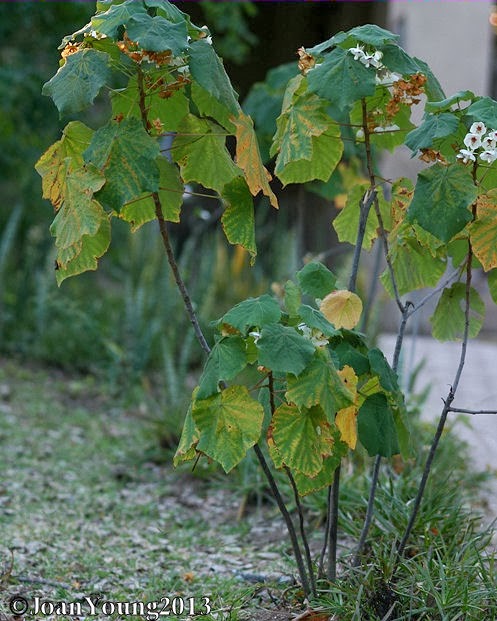
Silver White Pear (Dombeya pulchra)
Family Sterculiaceae
Distribution: The silver white pear occurs mainly on the northeastern Drakensberg from Swaziland, through Mphumalanga to the lower parts of Limpopo Province. It has a somewhat restricted distribution, as it grows on rocky hillsides or mountains at high altitudes, in wooded kloofs or in wooded areas along stream banks.
Description:
This plant can be classified as a shrub or small tree of up to 5 m in height depending on the area it occurs in. It is multi-stemmed and the slender branches are smooth, wrinkled and often covered with glandular hairs.
The velvety leaves n vary in size from 40 to 200 mm in diameter, are roundish to roughly triangular with the upper half sometimes lobed. The tips are pointed, the bases deeply indented and the margins roundly toothed with 5-7 prominent veins that arise from the base on the lower surface. The upper surface of the leaves is green and covered with short, dense hairs, whereas the undersurface is covered in silvery or greyish white, velvety hairs.
The velvety buds open into white flowers that often display a deep pink centre. They turn brown later. The flowers are borne on hairy stalks in bunches in the axils of the upper leaves. Flowering time: December to May. The fruit is a capsule and is covered with dense, yellowish hairs. The seeds are small, brown and pitted and are ripe between March and June.
Derivation of name and historical aspects: The generic name Dombeya, is in honour of Joseph Dombey, a French botanist and traveller in Peru and Chile (1742-1793). The specific name pulchra comes from the Latin word for beautiful.
Info: http://www.plantzafrica.com
Thursday, January 2, 2014
Wild Camphor Bush (Tarchonanthus camphorates)
Family Asteraceae
Tarchonanthus camphoratus grows from 2-9m high. It is a
semi-deciduous small tree that grows mostly in large uniform groups, but it
grows larger and more densely when it grows alone among other trees in the
bush. The branches and foliage make a V-shaped canopy. The stem is covered with
pale brown bark. Leaves are grey green above and pale grey and felted
underneath, with prominent venation on the underside. The leaves are narrow,
with entire or finely toothed margins.The creamy-white flowers are borne in a branched inflorescence on the terminal end of the branch. The fruits are covered with fluffy cottonwool-like hairs, and are produced mostly in March to November. These woolly, white fruiting heads are strongly scented and most attractive. Male and female flowers are borne on separate trees.
This interesting small tree with its attractive grey foliage is particularly suited to tough conditions. From sites blasted by wind and coastal sea spray to dry inland gardens, it performs well. It is even able to shoot from the base if burnt almost to the ground. If you are looking for a survivor for your difficult landscape site- this is it!
The name Tarchonanthus is derived from the Greek word meaning funeral flower. This name is divided into two parts, 'Tarchos', which means funeral rites and 'Anthos' meaning flower. It is unclear why this name was given, but Jackson (1990) suggests it may have to do with the camphorous smell. The name camphoratus refers to the strong smell of camphor given off when the leaves are crushed.
The camphor bush is widespread in Southern Africa. It grows in thickets of bushveld, grassland, forest and semi-desert. It grows mostly in sandy soils in the low-lying and sand forest of the coast.
Animals such as kudu, giraffe, impala and springbok browse the leaves of this tree.
There are only a few species of Tarchonanthus. T trilobus is also in cultivation. The genus occurs in Africa and Arabia. It is closely related to Brachylaena, which also provides attractive, grey-leafed, small trees for the garden.
Info: http://www.plantzafrica.com
Subscribe to:
Posts (Atom)