Saturday, August 11, 2012

Lions Tail (Agave attenuata)

Family Asparagaceae
Agave attenuata is a species of agave sometimes known as the "lion's tail", "swan's neck", or "foxtail" for its development of a curved stem, unusual among agaves.
 Native to the plateau of central Mexico, as one of the unarmed agaves, it is popular as an ornamental plant in gardens.
 The stems typically range from 50 to 150 cm (20–60 in) in length, and eventually old leaves fall off, leaving them naked and visible. The leaves are ovate-accuminate, 50–70 cm (20–28 in) long and 12–16 cm (5–6 in) wide, pale in color, ranging from a light gray to a light yellowish green. There are no teeth, nor terminal spines, although the leaves taper to points that fray with age. The inflorescence is a dense raceme 2.5 to 3 meters (8 to 10 ft) high, with greenish-yellow flowers.
 The original specimens were sent to Kew by the explorer Galeotti in 1834, from an unspecified location in central Mexico.
 More recent study has reported it from Jalisco east to Mexico, in small colonies at elevations of 1,900 to 2,500 meters (6,200 to 8,200 ft), but there have been few sightings, suggesting this agave is rare in the wild.
 In cultivation, Agave attenuata is said to prefer relatively moist loamy soil, although it can cope with poor soil and dry conditions. It should be protected from direct sunlight in summer and from long periods of frost.

Thursday, August 9, 2012

Sickle Bush (Dichrosachys cinerea)

Unmistakeable to identify as no other tree has a seedpod which curls up like this and the flowers are half pink and half yellow. This tree also belongs to the Mimosoideae family and is restricted to the central to northern parts of South Africa.
 They do not grow to great heights being 5-6 m at most. The pink half of the flower consists of sterile staminodes while the yellow half is fertile flowers.
  Cattle and game eat the pods of this tree with relish and various parts feature in African folk-medicine.
 The roots are chewed and placed on sites of snake bites and scorpion stings and the leaves are believed to produce a local anaesthesia and used for the same purpose and also as a remedy for sore eyes and toothache.
 The wood is extremely hard and durable and poles and axe handles are made from it.
  It has limited uses though as the pieces obtainable from it are small.

Tuesday, August 7, 2012

Botterblom (Arctotis arctotoides)

Family Asteraceae
This is a fast-growing, soft, herbaceous groundcover that forms carpets of light green foliage decorated with cheerful, butter-yellow daisy flowers almost all year round.


The leaves are 10-15 cm long with a wavy edge, the upper surface a fresh light green, while the undersides are white and felted, with the midrib quite prominent. The leaves and stems are covered with small white hairs. The single daisy flowers are formed on stems that are about 20 cm long. Each flower is about 4 cm in diameter and the centre and the petals, or ray florets, are a bright golden yellow. The undersides of the petals are purplish brown and are clearly visible when the flowers are in bud or closed during a cloudy day.
 On sunny days the flowers are frequently visited by bees, which are the main pollinators. Every flower lasts for a few days, even when picked for the vase. Small brown seeds are formed on the flat base in the centre of the flower within a month. As the seeds dry they drop to the ground, leaving the old flower heads brown and beautifully patterned at the centre-well worth a closer look.


The genus Arctotis occurs in southern Africa and Angola, and there are about 50 different species. The botanical name Arctotis is derived from the Greek arktos, a bear and otis, an ear. Just what part of these plants reminded the Swedish botanist Linnaeus of the ear of a bear is unclear, one reference calling it 'a Linnaean flight of fancy'! Arctotis arctotoides was once classified in the genus Venidium, which makes sense of the species name arctotoides, which means 'resembling the genus Arctotis'.
 This species, Arctotis arctotoides, is widespread throughout the summer rainfall areas of South Africa and Lesotho, usually in disturbed areas like road verges. The plants grown at Kirstenbosch were collected at Collywobbles in the former Transkei, now Eastern Cape.


The rural people of Eastern Cape are known to use Arctotis arctotoides for the treatment of epilepsy, indigestion and catarrh of the stomach, and the leaf juice or a paste of the leaf is applied topically to treat wounds. Studies have shown that extract of the leaf does have anti-bacterial properties.

Sunday, August 5, 2012

Adam's Needle (Yucca filamentosa)

Family Asparagaceae
Yucca filamentosa, commonly known as Adam's needle, is a medicinal plant native to eastern North America.
 Usually trunkless, Yucca filamentosa is a multisuckering plant with heads of 30 inch (75 cm) long, filamentous, blue green strappy leaves. The plant is fully hardy. Yucca filamentosa is readily identified from other Yucca species by white threads (filaments) on the leaf margins.
 Flower stems up to 10 ft (3 m) tall bear masses of pendulous cream flowers in early summer.

In the wild, Y. filamentosa is native to the southeastern United States, as far west as Louisiana and as far north as Virginia. However, it is widely cultivated and can be found naturalized outside its native range.


. filamentosa is closely related to Yucca flaccida and it is possible they should in fact be classified as a single species.

Yuccas are useful garden perennials because they bloom at night). The creamy-white flowers fill with sap and lift petals to the darkening sky then release a sweet odor.
Info from: http://en.wikipedia.org/

Friday, August 3, 2012

Desert Rose (Euphorbia millis)

Family Euphorbiaceae

This species is a hybrid and comes from India. It grows to about 24” in height and is a popular plant in our gardens. Many insects such as Carpenter bees are attracted to the flowers.
 Euphorbiaceae is the name given to one of the largest families in the plant world, sometimes known as spurges. It includes around 300 genera and 7,500 species, and of these around 870 are regarded as succulent. The IES is mostly concerned with the succulent genera: Euphorbia, Monadenium, Synadenium, Elaeophorbia, Endadenium, Pedilanthus, Jatropha and Cnidoscolus.
 Many species have a milky latex which exudes copiously when cut, and is more or less caustic. This does not apply to the Jatrophas and Cnidoscolus which have a clear sap, but on the other hand some species in the latter genus have stinging hairs on the leaves and stem and need to be handled with care.


Some species are widely cultivated, such as Euphorbia millii, the crown of thorns or E. pulcherrima, the poinsettia. E. tirucalli has been grown as a crop and almeidina latex used as a rubber substitute, but this proved to be unstable. However, it is still used as an ingredient in antifouling for boats. Hydrocarbons (fuel) have also been extracted from the species and a few others, but up to now uneconomically. Many species are cultivated unintentionally as poisonous weeds like E. esula, and there are many of the prostrate ones better known under Chamaesyce. Hard candelilla wax, a useful ingredient of polishes and waxes is produced from an Mexican succulent shrub.

Wednesday, August 1, 2012

Cobra Lily (Amorphophallus sp)

I came across a completely unknown species of lily and took some pictures of it. Trying to find out what it was, I found this interesting information......

Amorphophallus sp. Family: Araceae

Also known as: Voodoo lily, Devils tongue, Snake Palm, Corpse flower

Origin: Himalaya, India, Burma

Amorphophallus species are herbs with an underground storage organ. This is usually a tuber. One single leaf emerges from the tuber, consisting of a vertical petiole (stalk) and a horizontal leaf-blade. The latter is dissected into few or numerous small leaflets. Once plants are mature an inflorescence may develop. The inflorescence may replace the leaf in one season, or develop alongside it. From winter dormant tubers emerge an umbrella like plant with beautiful speckled stems.
 Large flowers will emerge from mature plants in the spring. When the spathe opens the female flowers are receptive and must be pollinated that same day. The opening inflorescence emits an attractant scent. In Amorphophallus this scent has diversified considerably. In most species the scent is anything but pleasant, and reminds one of varieties of death, decay, sewage, gas and the like.


A few species develop a scent that is actually pleasant to the human nose (e.g. carrot-like, anise, chocolate, fruity, lemon). After successful pollination most parts of the spathe wither and drop off, after which the individual female flowers develop into berries, containing the seeds. These berries are usually red or orange-red, but occasionally blue, white, or yellow-and- white.

Amorphophallus thrives in a rich loamy soil in partial shade. Compost should consist of 2 parts loam to 1 part peat moss to 1 part sand. Keep the plant evenly moist all through the growing season. Keep dry during dormancy, keep moist during growing period. Fertilize monthly with a houseplant fertilizer. Water should be gradually withheld starting in October until the leaf withers. Store corms at a temperature above 50 degrees. They can be brought into active growth in late March. If the corms are strong enough, a blossom will soon be produced.
 The leaf follows soon afterwards. A. bulbifer definitely dislikes low humidity - the leaflets may partially desiccate; this seems to be more pronounced in low light. Also, in low light, the leafes become exceptionally dark green, with nicely contrasting pink margins. Such plants have to be moved to brighter light very gradually. In bright light, the leaves are bright green, with pinkish margins less pronounced. Other species: konjac, titanum, and much more...


This information was obtained from:
http://toptropicals.com/catalog/uid/AMORPHOPHALLUS_SP.htm

Please have a look at their site to see some more very unusual flowers of this species.

Monday, July 30, 2012

Wild white Carnation (Dianthus mooiensis)

30/08/2012 Update: name and Family: Caryophyllaceae


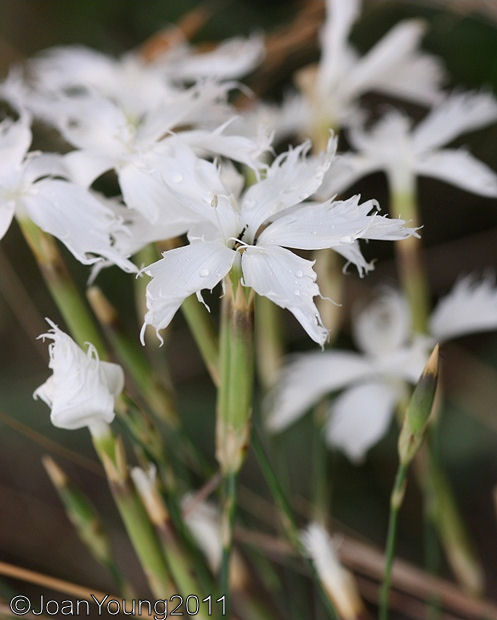
I never knew that there was such a thing as a wild carnation and being in a new area, I was excited to find some.
 These are growing in a bush area which is mostly grassland and the soil is very poor. The area was a river bed a few millennium ago and does not contain soil. The same as you would find in a child’s sandpit.
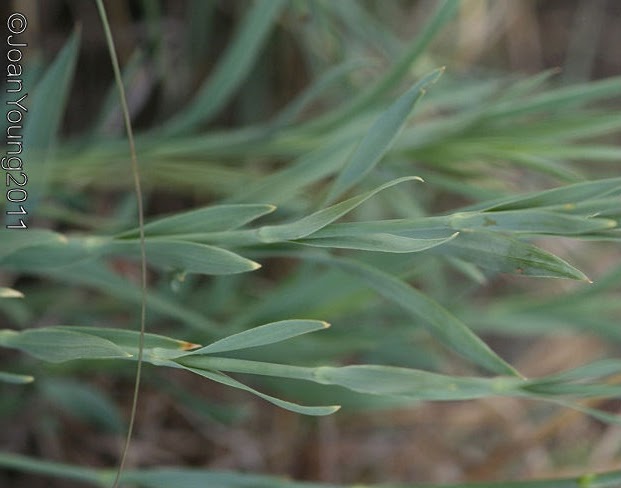
 These are thriving and as you can see by the pictures, the stems and leaves are very much the same as those we have cultivated and in our gardens, however the flower is very different and the calyx very elongated.
 I have only seen them in white and as they seem to grow in patches, they make a lovely show against the wild grass.
 If anyone knows the proper name for them or has more information, I would be pleased if you let me know.